
meet: Eden Ahbez
Born in 1908 as George Alexander Aberle, he spent most of his youth in orphanages, before he and his twin sister Edith Brewster Aberle were adopted by a family in Chanute, Kansas, and raised by them under the name McGrew. In Chanute he made his first steps as a musician, with piano lessons and first steps in playing the flute and xylophone as well. Alongside his twin sister, he got a first taste of performing at local clubs or meetings. Besides his musical interest, spending time in the wilderness as a boy scout was a very important influence. After graduating, he moved to Kansas City, changed his name back to Alexander Aberle and played in an Orchestra. By 1940 he moved on to Los Angeles, California, worked in a Retail Health Food Store, and lived with the owners, a German immigrant couple named Richter. They were strongly influenced by the German / Swiss Lebensreform-movement and this struck a chord in him. Following this movement’s philosophy, they rejected capitalism, materialization, as well as urbanization, and approached a life in state of nature. Many times, he travelled with Richters through the country, writing music along these trips. He also joined the Nature Boys, a group of young men, for their part inspired by Lebensreform- and Wandervogel-movements, went on a strict raw-vegetable diet, let his hair and beard grow. He lived outdoors (even built a little cabin for himself and his wife under the second “L” of the famous Hollywood-lettering), mostly used his bike to move, wore only sandals and changed his name for another, final time: eden ahbez was born. He avoided capital letters on purpose, because in his eyes, only God’s name deserves to be capitalized.
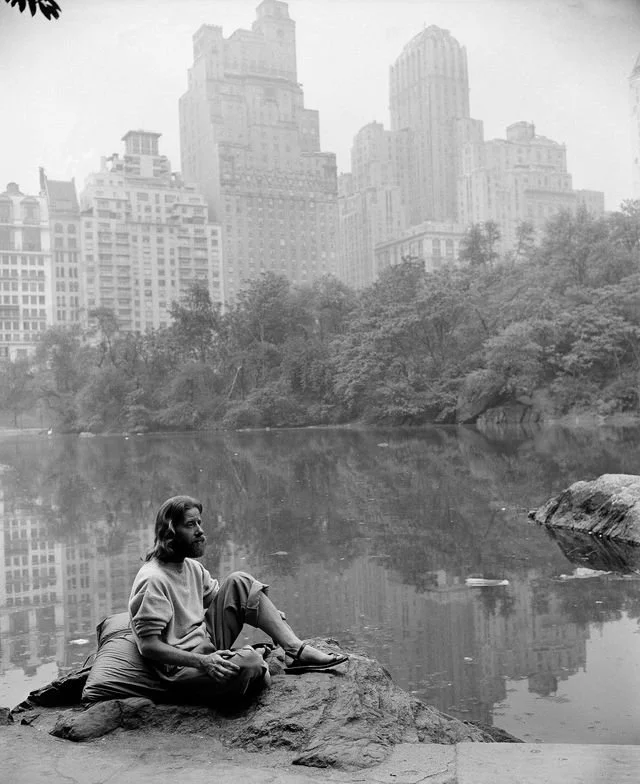
Ahbez at Central Park, NYC, 1948
As the legend goes, he tried to hand the sheet music of a certain song called Nature Boy to the great Nat King Cole in 1947 at one of his shows at LA’s Lincoln Theatre. Not complying the dress-code at all, he was refused by the doorman when he tried to hand it to Cole himself behind the stage, so he put it in an envelope without his address (because there simply wasn’t any) and gave it to Cole’s manager. Nat King Cole loved this piece, all about the wish for a live in accordance with man’s spiritual and natural state of existence in opposite to a state of trouble, caused by modernity. He tested the song several times on stage, with overwhelming response, so he wanted to get it recorded professionally. For this, they needed to find Ahbez to get the rights for the song but were unable to find him. Weeks later he was found and agreed to the recording of the song. It came out in 1948 and became a Billboard chart hit right away and stayed #1 for eight weeks straight. So it happened that a wider interest for the person behind the song rise in society.
Ahbez followed the invitation to join a TV show in New York to finally meet Nat King Cole, but refused the hotel offer and slept at Central Park instead (see second figure ).
Until today Nature Boy was re-recorded by artists of all following pop music eras, such as Frank Sinatra, Ella Fitzgerald, James Brown, David Bowie, Cher, or even Lady Gaga featuring Tony Bennett.
His share allowed him to carefree continue his 'Nature Boy' lifestyle, writing and composing on his travels. In doing so, he followed no success-oriented rules of the music industry but stayed true to himself. It took ten years after Nature Boy was released, until he recorded many of the songs he has written in the meantime, and Eden’s Island saw the light of day in 1960. A true masterpiece, which combines elements of Jazz with Exotica (Polynesian instruments, late 19th century classical music and Latin rhythms along real or imitated animal sounds) alongside his unique, mystical Spoken Word poetry. It is a wonderfully dreamy and heavily spiritual but still precise explanation of his philosophy illustrated by his very own words and sounds that take you far away.
He never claimed a musical career and lived a very frugal life, so far from public attention, he lost his wife Anna in 1963 and his only son Zoma only six years later. After that he spent the rest of his life in the LA suburb Sunland, still producing music (also under a new alias eden abba) until he passed away in 1995 due to injuries from a car crash several weeks earlier. Shortly after this, came out, including his work in recent years. This album tried to take up to the vibe of his first one, but in a kitschy way and is missing out on all the Exotica influences. Two compilations of his work followed in 2014 (The Exotic World Of Eden Ahbez) and 2016 (Wild Boy (The Lost Songs Of Eden Ahbez), which both focused more on the early work of Ahbez and his productions for other artists as well.
As the legend goes, he tried to hand the sheet music of a certain song called Nature Boy to the great Nat King Cole in 1947 at one of his shows at LA’s Lincoln Theatre. Not complying the dress-code at all, he was refused by the doorman when he tried to hand it to Cole himself behind the stage, so he put it in an envelope without his address (because there simply wasn’t any) and gave it to Cole’s manager. Nat King Cole loved this piece, all about the wish for a live in accordance with man’s spiritual and natural state of existence in opposite to a state of trouble, caused by modernity. He tested the song several times on stage, with overwhelming response, so he wanted to get it recorded professionally. For this, they needed to find Ahbez to get the rights for the song but were unable to find him. Weeks later he was found and agreed to the recording of the song. It came out in 1948 and became a Billboard chart hit right away and stayed #1 for eight weeks straight. So it happened that a wider interest for the person behind the song rise in society.
Ahbez followed the invitation to join a TV show in New York to finally meet Nat King Cole, but refused the hotel offer and slept at Central Park instead (see second figure ).
Until today Nature Boy was re-recorded by artists of all following pop music eras, such as Frank Sinatra, Ella Fitzgerald, James Brown, David Bowie, Cher, or even Lady Gaga featuring Tony Bennett.
His proto-hippie way of life, as well as his music inspired the following Hippie movement, influenced genres associated with this era like Psychedelic Rock and is still present in pop music until today. About seventy years later, in the present moment, the values he departed from have intensified significantly and climate change as well as natural destruction are constantly on a rise, so listening to his music feels like a solastalgic meditation and a broad hint at the same time.
